What is a cataract?
We are born with a perfectly clear, flexible crystalline lens. With age the lens hardens. Usually around age 40+, this hardening leads to a loss of near vision (presbyopia) and signals the need for reading glasses or a bifocal lens.
As the lens continues to harden it loses its clarity, and develops imperfections that begin to affect the quality of vision (this imperfect or aging lens is a cataract). If not treated, a cataract will progress to impair the vision and eventually can lead to blindness.
How do I know that I have a cataract?
Symptoms that may indicate a maturing cataract include:
- Glare or halos at night
- Trouble driving at night
- Blurred vision
- Frequent changes in your glasses prescription
- Difficulty distinguishing colors
- Trouble reading fine print
- Difficulty reading road signs
- Other noticeable changes in the quality of your vision
When do I need cataract surgery?
Cataracts grow slowly and are diagnosed long before symptoms start or treatment is needed. Eventually as the cataract “matures,” symptoms worsen, and surgery is recommended. The decision for cataract surgery is one that the patient and doctor will make together. Some patients have a high tolerance for imperfections in their vision and will wait longer for surgery than others who are affected by minor visual disturbances. The good news is that there is rarely any need to rush into cataract surgery and the procedure can usually be scheduled at your convenience.
Fortunately, advances in cataract surgery have made this procedure not only one of the safest, but one of the highest rated in patient satisfaction in all of medicine. While outcomes are almost universally good, cataract surgery is a major surgery, is not risk free, and complications can occur.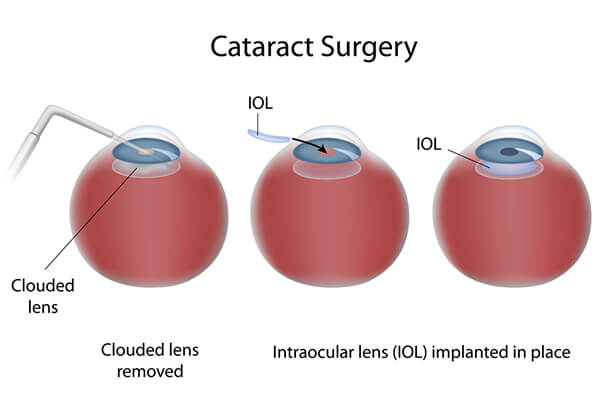
What is cataract surgery?
Cataract surgery involves removing the lens (cataract) and replacing it with an intraocular lens implant. Cataract surgery is typically performed through a small incision that does not usually require sutures. Cataract surgery typically takes less than 20 minutes and you can expect to stay in our Coeur d’Alene surgery center up to three hours. Patients tell us the procedure is comfortable and the overall experience is pleasant and life changing.
Our Coeur d’Alene and Post Falls surgeons offer a full line of intraocular lenses designed to correct a range of vision problems: (Monofocal, Toric, and Multifocal Lenses).
Monofocal Lenses:
(generally fully covered by insurance)
A monofocal lens can be customized to give clear vision at a single distance without glasses in most eyes. If a distance target is chosen, reading glasses will be needed. If a near target is chosen, distance glasses will be needed. If astigmatism is present, glasses will be needed for distance and near after cataract surgery.
Toric Lenses:
(additional cost – not covered by insurance)
A toric lens is needed to achieve clear vision without glasses in patients with significant amounts of astigmatism. Toric lenses will correct either distance vision or near vision without glasses in most eyes, but not both. Toric lenses are recommended in patients with significant astigmatism, but are optional given the added out-of-pocket expense.
Multifocal Lenses and Multifocal Toric Lenses: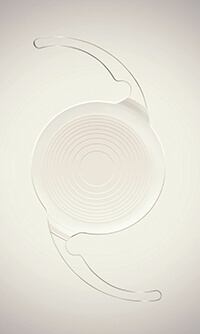
(additional cost – not covered by insurance)
Multifocal lenses have the advantage of correcting distance vision and some near vision without glasses. While glasses will likely still be needed for some tasks, a multifocal lens gives some degree of glasses independence at both distance and near. Not all eyes are candidates for a multifocal lens and certain conditions prevent the multifocal lens from performing as designed. Your surgeon will help you understand if you are a candidate for a multifocal lens.
Monovision:
(Generally fully covered by insurance)
Monovision is a technique using monofocal lenses where the dominant eye is focused at distance and the non-dominant eye at near, decreasing the need for glasses at both distance and near. With Full Monovision, the near eye is focused for comfortable reading, and the other eye for distance. Depth perception will be decreased, and some people won’t tolerate such a difference between the eyes. We usually offer this only in people who have done this previously with contact lenses and tolerated it well. Modified Monovision sets the near target at arms length, which allows the eyes to work together while still offering some vision at near. With this option you are relatively glass free, but may need glasses part time for driving at night or reading fine print.
YAG Capsulotomy after Cataract Surgery
More information on cataract surgery is available on the American Academy of Ophthalmology website by clicking here.
Contact North Idaho Eye Institute today to schedule your appointment and find out if cataract surgery is right for you.